
GABE

Gabe aka Gabriel aka DJ Ultra performing his set at Camp Louis Routh,
"a secure detention for delinquent minors in juvenile halls And rehabilitation programs---permanently closed," Tujunga, CA (LA-County.gov)
Gabe was born and raised in Los Angeles, CA where music has always been a part of his life. Music is his culture. Being raised in LA introduced him to the sounds and words that still play in his ears—music being his drive to survive. There was something so special and interesting to all of it that kept Gabe coming back. When he was home, tucked away from the mix of music and from the hecticness of the people roaming Los Angeles, he was in the company of parents who shared the same love for the arts. He grew up surrounded by records and started collecting his own when he was just a teen. Overtime he has collected thousands of records.
Gabe’s father taught him how to play the acoustic guitar at 11 years old and he has been hooked ever since. Gabe is left-handed but learned how to play the guitar right-handed. That’s all his father knew so that’s what he taught him. Gabe never questioned it. At 13, he was running away from home and never forgot to take his father’s guitar along with him. He still has the same guitar today—it holds some of his earliest music memories.
Gabe is also drawn to film and literature. He dipped into writing and poetry when he began practicing music. He was inspired by Jim Morrison, trying his best to follow in his footsteps, “Poems become the lyrics in your songs. I would go back into my journals and poetry books to find the right words. The right thoughts. The right moments. I would then turn these words into songs.” At the young age of 17, Gabe was already writing his own songs.
Throughout his life, he has played in lots of bands. When a member of these groups, the times seemed promising in that he’d able to play guitar every single day for the rest of his life, but as he got older, this fantasy faded. “You just don’t have the freedom to be as loud as you want to be all the time. The older I get, the more inhibited I am by my surroundings. I can’t be as open as I would like to be, but I’m slowly getting back to it.”
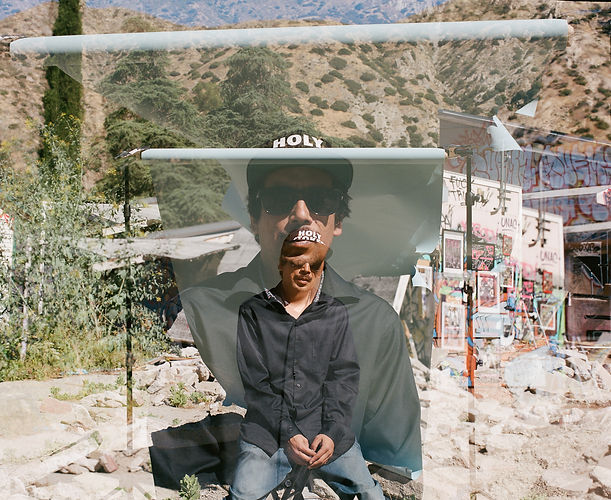
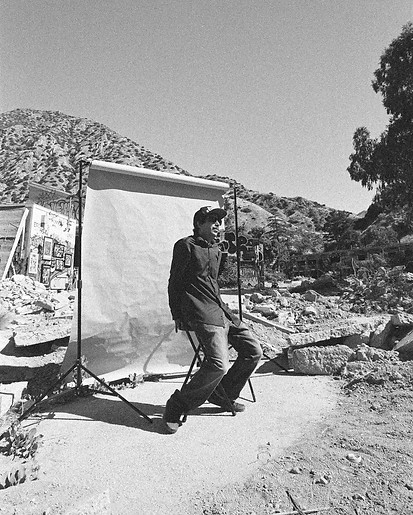


At 16 years old, Gabe was a student at Eagle Rock High school—but really, he was a musician before anything else. His group of friends all shared the same taste in music and spent most of their free time talking about music: favorite/worst bands, new forms of music coming up, who are the best groups of all time. To Gabe and his friends, their backpacks were their guitar cases, glued to their hands everyday at school. It was Eagle Rock High where Gabe participated in his first battle of the bands. Gabe was on the electric guitar, his friend was on drums—"my friend actually lied to be our drummer...they did not know how to play drums, but it was ok."—they all lied together and figured it out along the way. It was a moment in his music career that let him feel, really on top. Despite all the stress and not having all of the answers lined up, it all worked out the way it was supposed to—it was an experience that gifted a type of motto that influenced a lot of Gabe's creative life.
Gabe's journey through the child welfare system intersected with Journey House's past history, Gabe was a former resident of Journey House's group home days. Sharing with us that music was what helped him build a foundation for himself while in the system, acknowledging that everyone's journey through foster care looks different but music is what worked for him. He was thankful for the freedom and space Journey House provided, to not only be a space where he could play the guitar, but also a space where he was encouraged to bring his band together. He wrote a lot of his songs inside Journey House, when the now 2nd floor offices used to be bedrooms—he remembers the days he jammed out in his room while the other group home boys watched wrestling downstairs. He played his guitar every single night. He would blast it and sing as loud as his lungs would allow. No one ever asked him to stop. Gabe remembers the Journey House group home as vivid, a home that always inspired him to keep creating, supporting his interest in music however they could.
“I would get home and the first thing I would do is play my guitar as loud as I could and jump around like a brat. It was nothing but hours of loud music. But the older I get, the more I don’t want to piss my neighbors off. If I had a little room just for me where noise didn’t matter, I know I would still be doing it.”
Gabe admits that participating in the We Are Healing project has re-sparked his passion and desire to keep playing. To keep making music.
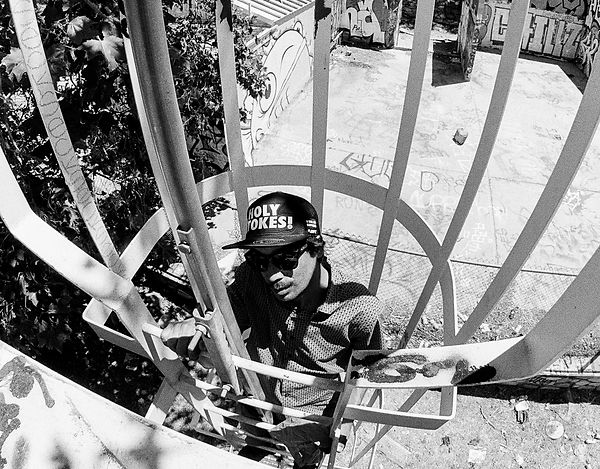


The Waifs are a punk band that Gabe was a member of in high school, which is when Gabe was also part of the Journey House group home. The term Waif is defined as: a homeless, neglected, or abandoned person, especially a child. The beauty of underground spaces like the Punk scene, is that everyone is allowed to show up as their true selves---Gabe's work with The Waifs is an exciting entry into the larger history of the foster youth community, at one point because of Gabe's labor, their was a foster youth guitarist creating music from inside the constraints of the child welfare system.
To Gabe, songs are power, whether he is the one writing them or listening to another artist’s creation—songs are weapons. Whenever he encountered difficult hurdles as a youth navigating the child welfare system and wanted to let it all out, he got to writing. He would write a fictional song and then turn it into a joke. “It could be ugly, silly – anything really. I could do whatever I wanted with it. It gave me the freedom to express myself in a way that’s positive. I might be the only one to hear the song but even that was healing. I let out all feelings of frustration, of fear. I let go of depression.” It didn’t have to make sense. He didn’t have to break it down for anyone. No one has to understand it. Gabe takes pride in his process and would rather laugh about a situation in a song, then explain how he feels.
Music is Gabe’s escape and greatest weapon. He didn’t think he would make it out of the child welfare system. Or even finish high school. He didn’t know where he would end up. Gabe very often found himself stepping away from music out of necessity. Life happened and, in those moments, he was pulled away from practicing what he loved so much. He was in and out of bands. Other times, creative differences ended things. Time itself is tricky to navigate when you the responsibilities of the world fall on your shoulders at such a young age.
“Music was always there to get me through the hardest parts of life and the day I stopped depending on it to save me, was when it showed up and really proved it could. It was evident it would be what would rescue me when I needed it.”


Gabe's home is in punk rock, it is one of the rare genres of music that accepts all of your mistakes and sometimes it is better when you are not perfect! Gabe was always one to take what he had and run with it. He moved through life with the same flow and style of punk music: "Life wasn’t always going to be nice and what you expect, but you must keep going." This is Gabe.
Gabe's writing process, like most songs, starts with an emotion. Gabe always carried his song ideas in notebooks and journals. One of Gabe’s favorite journals was titled “Bad Ideas.” Gabe wrote close to 100 songs and can even sing all of them. He used drums to write his beats and when it was time to writing lyrics, he busts out his guitar. Everything flowed out until there was enough said to become a song.
He has two songs that are great examples of how he let out what he was feeling in that moment: Ski Mask and Shotgun. These songs expressed his frustrations with trying to survive the systems of exploitation that demand everything from us with no promise of a futre. Stories of having no money and being put into a corner where the only way out is to turn to a life of "crime."
“Ah I also just remembered one I made with my brother. Together we made about 15 songs. We were always messing around. One I really remember is called “Douchebag City.” It was about LA.” Gabe fights to hold in his laugh as he shares this memory.
His brother created the bass line and he came up with the verses. “I live in douchebag city.” It was a fun way to talk about what they went through in Los Angeles. It was about the type of people they came across and would run into daily and how horrible they were to them. It was a fun way to vent and have a laugh about a situation, especially since a lot of people would understand where they’re coming from.
Jack o Blues was a song he wrote that was special to him for other reasons. He wrote it 15 years ago. It is about hustling and surviving. He was going through it after the loss of his best friend, Faith. He met his current partner around that time. They were running around LA being broke and desperate. Living on fumes. It was a very difficult time in his life and he still turned to music to help him through such difficult times. It didn’t mean it was the answer, or that it solved his pain, but it was one of the few places he felt understood.
Gabe went to film school and used his assignments to record and work the production of his song, Jack o Blues. He even made a video for it. It was under revision as an assignment, meaning he would receive a letter-grade, but this didn’t stop him. He knew he would eventually make the video anyways, so why not just do it? Gabe took advantage of the places he was in and if he could somehow bring music into spaces as his plus one, he was all in. This undercover production really speaks to the importance music has had on Gabe's life and continues to have in Gabe’s day-to-day life—music is Gabe's home.

Gabe’s Dj name, DJ ULTRA, is a crossover of a Zine he was a part of, Voices From The Underground—an independent publication that explored LA night life and culture through interviews. At the time, he was known as LA ULTRA, but he wanted to capture the feeling of an all-inclusive, exciting, and never ending parade of LA life. That’s when he stepped up and claimed DJ ULTRA.
Gabe spent his entire life amassing a huge record collection and considered his records to be members of his family—he never thought to DJ with records until the day he had to sell his collection for money to afford rent. “I could’ve been a Dj this whole time. Well, shit.” Gabe got back to collecting shortly after selling his collection and after 8 years of re-gathering, he decided to never sell a record again. Nothing, not even rent, was worth the loss of his music.
As DJ Ultra, he booked shows, interviewed bands, and played at lots of parties. Gabe dedicated a lot of his time to playing between sets at shows. He didn’t have the real gear many used, but a tape deck did the job. He already had all the weird tracks lined up. He played old tapes he stacked up throughout the years. He made sure to stay ready and was open for any opportunities that came to him.
One of his most memorable sets took place in 2018—Gabe DJ'ed for his friend Casper’s skate party. He was spinning for 5 hours straight. Gabe knew at that moment that he was doing something he loved. They were so special to him. That same joy and feeling he felt, translated to the audience. “The longer I played, the weirder it got. People loved it.” Gabe aka DJ Ultra is a selfless artist, looking to spread joy through the weird and exciting mashing of sounds from across space and time.


DJ Ultra's process as a teen: find a song he likes, obsesses over it, and keep it on repeat. He would record his favorite songs off the radio and either transform a whole tape into one repeating song, or manually rewind the tape to hear the song. His selected songs each identified with a struggle he was experiencing in that moment. He built a soundtrack to his life, putting emotions into words: “I had to hear it again and again. I couldn’t get enough of it...they helped me a lot.” These soundtracks are engraved in his audio graphic memory. They bring him back to a moment when he needs it most. Memories live in these songs and Gabe is just happy to have them—even if it means he needs to manually turn it all back to feel it again.
Gabe's ability to create music led him to a life on the road, traveling for mini-tours. He visited the Bay area the most, performing mostly in San Francisco. His work even led to a few shows in Orange County, Ventura County, traveling as far out as Nevada City. He really enjoyed these moments because he was in a small dingy venue filled with the most random set of people, but connected through a passion for a really weird set of music. Each gig was like a temporary home, filled with people with similar anxieties and with some answers hidden in the music.
“In my 30’s, my processes began to change. The way I looked at the world changed. Music got me through everything.” Gabe feels as if he was always struggling. “There was this unbearableness of the world—how I am a part of it and suffering in it like everybody else.” It is music that helped him, to find enough faith in himself to keep going.
During Gabe's fight to keep going as he worked himself through the child welfare system, he met Rico, a staff member at his placement. Rico's punk background quickly made him a close mentor in Gabe’s life. Rico played in his own band, was a big music fan and supported Gabe's pursuit of music. Years later, Gabe would even play at shows with Rico.
Rico was more than just a fellow Punk—he offered Gabe advice, to help him in his quest to find answers in the chaos of the life of a waif, advice that has stuck with Gabe. Rico shared the importance of having and using a healthy outlet, emphasizing to Gabe that your outlet doesn’t mean you have to have everything figured out: “Get yourself a job. A nice place to live. Figure that shit out and then you get to be in a band. Make music and do whatever you want to do.”


When it comes to performances and anticipated sets, DJ Ultra admits to avoiding the traditional ways of preparation. It’s all meditative for Gabe. He spends two weeks thinking about it. Dreaming about it. And when it’s time, it’ll all come out the way it’s meant to. It is almost as if he is sitting with his ideas and letting them marinate in the most natural way possible: “It’s the most honest way for me.”
Gabe feels best when he can just lose himself in his performance, allowing the best of him to come out when his guard is down. Something comes over his body and he easily comes up with the next chord, the next word, the next record to play. He is always one step ahead.
“When I’m DJing, you’re watching me figure it out. I’m never afraid to put myself in a position where I’ll make a huge fool of myself. If there’s not a chance I’m gonna screw it up, why bother?” 9 out of 10 times when Gabe books a set, he has no idea who these people are. He doesn’t know what they like, what their home looks like, but he’s always ready to jump in headfirst. “I don’t wanna worry about it. I know it’s gonna be cool...really cool.” Gabe finds it easier to do something when he can’t see the end of it. He doesn’t know how it’s going to work out, or if he’ll even be strong enough to complete unexpected sets. It's when he's in a space he doesn't know, that’s when he can give his music his best shot. In the infinity of the unknown, he has no other choice but to fight.
If the stakes aren’t high, he doesn’t want it. It’s been the way he moves through his music practice and it translates to the way he lives life. Jumping in is not as scary as sitting and thinking, “How am I gonna do that?” Gabe doesn’t spend too much time worrying about the details. He just focuses on the fact it’s going to work out.

Today, DJ Ultra's neighbors are obnoxiously loud and are always hogging the balcony. They talk loud over the phone and never consider their surrounding neighbors. In these moments Gabe is always tempted to go out and play his songs—they need to meet DJ Ultra! He imagines himself playing at the loudest volume just like he did back when the rules didn't matter. It's all for laughs.
Gabe is focused on honing his music skills and equipment. Always ready for the last minute gig that keeps him on his toes, challenging him and keeping his night interesting. DJ Ultra is not repetitive, he will stick to his outdated worn down analogue style, ready to bring his 80's/punk/goth mixes back out into the world.
“I was always defiant by nature. If you tell me I can’t do something I’m going to think about how I can do the opposite. This pull to the stage, the pull to keep DJing is like a dare. I was always shy growing up. Before my poetry and picking up instruments, I thought I would stay there. You must break through it, break through the feeling of staying quite.” If you are fortunate to find yourself in the middle of a DJ Ultra set, you'll find the dare—to go after what scares us most and trust the best is always on the other side.
