
ERIC

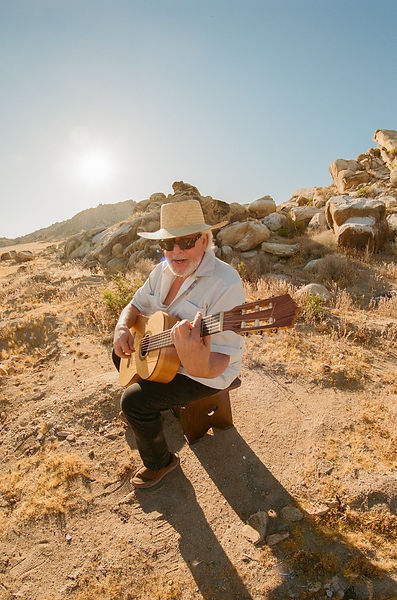
Eric standing amongst a natural pillar of stone, watching the world unfold from the top of the hill.
How our camera did not burst into flames, how the bottom of our shoes didn't melt off, and how Eric played his guitar while not submerged in an ice bath—we will never know. This photoshoot and conversation took place on another planet, where at 7:00am the heat is tearing up your skin and you sweat off a pound of water by 7:15am.
Eric took FYPC on trip through his backyard, where all of our artists described the final images as being shot on Mars—and in between the rocks of this constantly concaving valley, Eric brought his instruments to life. And in this private performance, Eric sung his song with the force of 3 generations of musicians—his breath, bringing out his birth in a house of music. He sang at the sun, his airwaves crossing the oceans of dirt and rocks, an ode or offering to all that created him. The heat kept pounding and pounding and Eric still played. With every minute we stayed to photograph, we noticed that rocks sweat, that the mirage of water grew into a oasis that would always be out of reach, that vultures begin circling at the smell of sweat—and in the middle of it all, Eric never stopped playing.
We tried our best to locate a backdrop that would best suit Eric, an object that represents his full depth of music knowledge, his timeless fashion sense, and the strength he exudes—to find out only that, his shadow dwarfed it all.
Please check out our full conversation with Eric below, at the end of this conversation we hope you find the same playfulness, thoughtfulness, and immense joy that all folks have felt in the presence of Eric—we say this all with the knowledge of how much Eric can never take a compliment:


FYPC: Can you please share your name and your first thoughts when you hear "music" and "music therapy?"
ERIC: My name is Eric Reyes—music is a huge part of our life experiences and so I don't practice a specific type of music therapy. Those who aren’t familiar with music therapy, I would say that music is everywhere and it can be done anywhere.
I believe all humans, and living creatures, no matter where we are in life spans and experiences—find some form of appreciation of music.
FYPC: Thats great and very true! We want to learn how music has showed up for you in your life. Can you remember the first time you sang, or picked up an instrument? What made you gravitate towards this specific form of self expression and art practice?
ERIC: My entire family—my parents were musical, my mom was a Mexican folkloric singer and she went by the name: Mara Reyes. We were always listening to music in my household, our entire life. From birth, until now even. My mother had some really great songs, she was a great performer, she won awards—she sang at the Million Dollar in Los Angeles. It was just wonderful to be exposed and growing up in all that, she also danced flamenco music and my father, he’s pretty good at guitar and always accompanied her, so music has always been a big part of our entire lives. It was mainly a lot of mexican folkloric music, but you know I was exposed to a lot of jazz and blues and I think it's because I grew up in South Central Los Angeles, I was in a predominantly Black neighborhood and church was a big part of our lives—I was raised Catholic. My parents sang choir in the Spanish mass. I remember Mariachi in and out of our house as I was growing up, my father bought me my first guitar from Paracho, Michoacan when I was about 7 years old. He also bought me a book that helped me learn the chords.
I grew up in South Central, but there was a period where I had to go live with my grandmother in San Ysidro—that's when my dad bought me my guitar and where I learned how to figure out the cords. So I was pretty self taught and at the same time, I was very observant and seeing how other people were playing—I asked a lot of questions and every time I saw someone playing an instrument I felt like I had to go and sit there with them, just paying attention to what they were doing. It was always soothing to me to just sit there with them.
My neighborhood, church, inside my house, my parents—I was learning and appreciating music from being in all that.
FYPC: To follow up on your childhood neighborhood—How did living in South Central in that particular point in time, impact your journey through music?
ERIC: it was very impactful growing up in South Central Los Angeles and the exposure that I had living with my parents, with Spanish music and African American Music. The music in the spanish speaking and english speaking communities—their were just differences in how music was celebrated. That was a great positive impact in my life, to be exposed to differences in music and styles. I fell in love with pretty much everything…my father would take us to the Watts Towers and talk to us about music and how he grew up. I learned a lot because of music.
FYPC: As you brought up this topic of a multi-cultured lens you experienced music through—it makes me think of a phrase our crew members built together: creating music from the margins. What this means to me, at least, is creating music from an identity, that in the US, has been pushed aside, has faced oppression, has faced long forms of violence or policing. And I think South Central is a city where you can see a long history there of these themes. Can you expand on this interaction you are having growing up—with a Mexican, Mexican-American music and this Black experience in music—especially how this music might have shown up in the form of resistance? Did it impact your approach to music?
ERIC: I think that historically, music expression—or the language that is used to convey an emotion, can come from some really dark places. I do have to say that I was living in South Central, but I was also exposed to East LA, which I also loved….but there….I don't want to make anything up and so to be honest, a lot of the music I did hear, a lot of those songs were sad and had to do a lot with violence, and experiences that had to do with immigration—in East LA, I was also exposed to Afro-Cuba rhythms and that also played a big influence. That pathos, and that feeling of the historical and what happened to these groups—you know Soul Music and even Creedence Clearwater Revival, which is a group of white dudes, but I like to think of their upbringing and where they came from. Their was just this different mixes and roots and the stories all had to do with some life situations…I can say that sometimes the situations were dark, a situation with some light, a situation with thankfulness—but growing up in a Black community, were slavery was real and systemic racism was real—it wasn’t a matter of belief, its real and it happens, so thats probably why most of my clients are people of color. Their is something that I feel from my heart, this historical pain, or historical realities.
I think music transcends Black and white narratives that are presented by the people who may not really understand what it is to have suffered—they are cultural differences—some don't give a shit and I have experienced that as well.


FYPC: I do know that you and I share a Mexican American identity. And since I have you in front of me as a musician that shares this identity—I want to know how you approach music as a space of healing, especially with these historical forms of silencing that our identities have experienced? I think our identities do have this connection to a spirituality that many in the US might dismiss because its not concrete, or visual—
ERIC: And that spirituality part is in the music—just having interactions with other people who play, and improvising, improv is really important. It's not verbal, we're communicating without the use of words. And we're trying to communicate some sort of an emotion or a feeling or a thought. And it's after we're done playing in therapy, we talk about what was going on in your mind at the time. Being Mexican American has a lot to do with my own father's journey and who adopted him—my father was adopted by a Mexican family. So, I don't know if I talked about that. When it comes to identity, music, and healing—it's not what anybody else says it is. It's what I'm saying it is.
FYPC: Their is a Mexican American cultural approach to music—I think you touched on it earlier. In the songs you described, you hear folks talking about heartbreaks, you hear folks talking about Migration, policing? I am wondering how these topics came up for your families journey through music?
ERIC: I heard it in the music and I did feel it! We had family that my father would bring across the border in the trunk of the car. One of those people was Ramon, he was a guitar player and he lived in our family for a little while. He came to the United States to find work, he always had this really happy demeanor and music was important to him. In fact, he gave me his guitar and he would explain the significance of that guitar to him. He would say: “it is shaped like a woman” and the “strings are like her hair, and she’s been with me in jail” and he was very thoughtful in how he would describe the instrument and the love for his instrument. I think that experience is what led me to want to serve unaccompanied children, I learned a lot in that process too. Their are cultural differences, even linguistic differences at times, different variations in how these children express themselves—the majority came from Honduras, Guatemala. I am trying to get creative in how we can communicate across our cultural differences.
FYPC: I appreciate the story of Ramon coming across the border and bringing something across that border—music and also not just the music, but the history of those songs and of that practice as a form of healing. When you were working with unaccompanied minors, you shared that you were working with broken instruments—it's poetic that you use broken instruments in your therapy practice with unaccompanied minors. I think there's so many layers there around using something that isn't working to help heal. Can you share more on how you approach music as a practice for all people?
ERIC: I don't know if I can [laughs] its not something that I typically do every single day. In playing with live bands, I have done with music with a lot of people, I was in the Seminary and when I was there I did play music in Santa Barbra. Music was big there! I was exposed to a lot of different peoples and cultures, but I got to keep stressing that I do use music a lot, I am not using it as a music therapy. When I do therapy everyday, it's not all music, but I feel music is inside of me no matter what. I've been told, “you know you always look like you are listening to music” [laughs]
I hope that music helps a client open up about narrating the story of what happened to them, especially in the juvenile dependency system, but getting somebody to open up and discuss things that are emotional you have to do it within clinical constraints. I think thats why it's important to incorporate music in therapy, especially when you're trying to help somebody and you are trying to establish a good rapport with them. And if I see that they like music, I am going to make sure we talk about music during our session! It might not work for everyone, but when clients show me in small ways that it might work for them—we'll lean into music together and see how it might help them open up.
FYPC: Does your cultural upbringing influence this approach—I think right now, you are saying music is everywhere, music is inside each of us. And I am going to add a little bit of context from my background here—I fell in love with Chicano writing, because it was romantic, fictional and non fictional, all at the same time. It blended the lines between real and feelings. It's similar to maybe how you describe music, a focus on vibrations. When listening to a song for the first time, feeling the music first before thinking what the song might be trying to say—how did you adopt this method into your approach?
ERIC: I've adopted that very exact same approach to music and and what you're saying is spot on. I think one one of the influences in my life has been my parents, my father in particular, who again, was adopted. He struggled with that identity, he shared that with me and he's Catholic, so he incorporates theology with his understanding of the meaning of adoption. And, and so how he would explain that we're all God's children. I have a very deep spiritual life, but I'm not trying to proselytize or anything, but my father always said something that was interesting about our people.
He would say that if you're gonna try to reason with Latino's—and he would have these Bible studies with gang members. He would tell me that it's important when you're talking to Latinos that you speak to their heart, it's really the heart that you're talking to. And I'm still trying to wrap my mind what that truly means. I think it means that that we have these feelings. All people have thoughts that convey these feelings. And many people just stick with the idea, that our thoughts happen as a result of what we might be experiencing, and so they only want to stick to what's "factual." Okay, we're back to that clinical training.
In the 80's, graffiti was a big part of life in South Central. My dad said, "Well, if you want to get somebody to stop putting graffiti on liquor stores—just paint a picture of La Virgen de Guadalupe on your store." And that's what's gonna get a gangster, who may believe in the miracle of our Virgen—they're not gonna try to put graffiti on that. Now, that's not 100% true [LAUGHS]. Because yes, they do. And yes, they have. But it still stuck with me because it spoke to my heart.




FYPC: What practices do you engage in, to tap into these creative mindsets? And I think it's kind of what we're talking about right now, around spirituality versus something a bit more Western—where you have to explain what you're doing, instead of feeling what you're doing. So when I am saying "mindset" that's what I am referring to—I am feeling a stream of thought coming.
For me, I think of a sunset in 1960's San Francisco. An atmosphere of: anything is possible. And again, I'm kind of more on the historical side. So looking back at that time, it felt like in that space, in that city, in the 60s, there's these moments of people building off of this energy of challenging the 50's, challenging racially violent pasts, challenging the establishment. We move into, experimenting with different substances, experimenting with ourselves, and really just allowing ourselves to be as "free"—which looks different based on your race/ethnicity, gender, sexuality in this country—but just in this larger context, I'm just going to describe it this way. I'm with my thoughts on the edge of the world. I get excited of thinking of your approach to life, Eric, and maybe because I was so closed off to everything while I was in the foster care system, and you're someone who seems pretty open to a lot. I'm seeing you as a Jerry Garcia kind of figure—
ERIC: Not the first time I have heard that [LAUGHS]
FYPC: —a deadhead that doesn't let too much bother him. A Jeffrey Lebowski type—The Chicano Dude. And so my last question here, with that context: What does the inside of your mindset look like, sound like? It does not need to be so hectic like that one.
ERIC: I see the 60's, moving from one system to another—I think that there's, there's good social workers, and then there's really shitty social workers that want to look at things from their own lens—the majority of my clients are people of color, because of how I find a reason to relate to them—
If you want to sing about systemic racism, you can. If you want to complain about a particular institution, you can. You can do it in your language and in any way you want. I think music makes that venue a little bit easier, not just music, all art. Like dance, but I cant dance—I don't want to be dishonest.
I am not here to sit and judge. My motto is: don't judge, just observe like ants. Just observe. That's it. Mental health is awareness, awareness, awareness, awareness. [LAUGHS] I hope that was as good as your stream of thought.
FYPC: That was perfect and imperfect at the same time!
ERIC: When I am working with my clients, I am always the lighthouse—they are the one's steering the ship. I get to just be their guide and they create music as perfect, or as disastrous as they feel. If someone is feeling sad, we are going to feel sad, not jump out of that—music should be a reflection of what we feel.
Music has healing properties. Music keeps it real. Music allows me to just be myself and I don't care. We try to heal as therapists, we try to heal the world. Healing comes from expression, healing comes from awareness, there's not much you have to do to achieve awareness, other than just accept what's happening. And then have an opinion about it.
Music is just one of the avenues to share that opinion and to convey a sense of peace in a person's life.
