
ANDRES
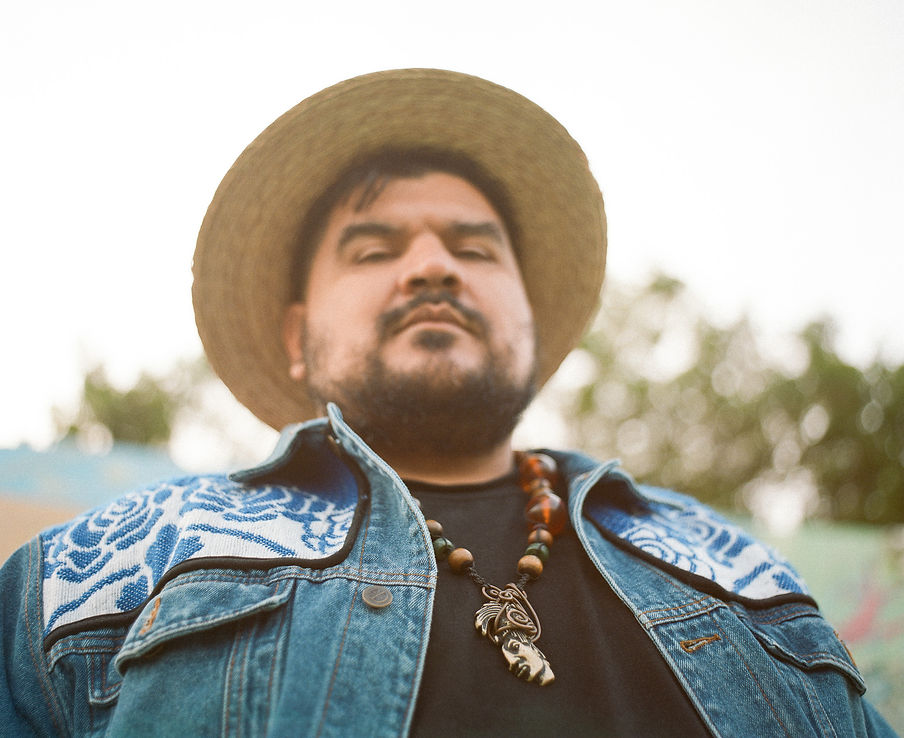
Andres aka Mayazteca is an embodiment of theory in practice---moving with a sense of comfort because he has found his answers, only after a deep uncomfortable conversation with himself.
It is Guerilla Hip-Hop, the beats that are born from under the earth——taught oppression, found sun only by muscling through, ripping mic’s out of hands feeding you lies. The work of Andres takes place on two fronts: lyrical spitting in booths and lyrical spitting in healing circles.
We met Andres at The California Catalyst Center’s annual Thriving into Adulthood Conference in Pomona, CA. Andres stood on stage, presenting his body of work on “Play Therapy” in Los Angeles and its impact on the healing journey of his clients—his presentation was different from others at the conference. First, his work wasn’t taking place on a university campus, behind three layers of security guards/paywalls/egos—it unfolds in his city, on the same streets where he pumps gas at night, where fear is not his first emotion when he hears: Inglewood, Watts, Compton.
Second, his story telling is not done through a research essay with graphs, data banks, and a language meant only to validate itself—he speaks with emotion, of how Play Therapy works, and shares “anecdotes” that explain where radical thinking can take us.
Third, he doesn’t turn his back on anyone—in that, he works with everyone's mistakes. That he looks at Oscar Acosta as someone who is powerful because he was his truest self, even if he was on his path of self-destruction, and even if at times he reflected the worst of ourselves. Unlike many others, Andres would be there after all the mistakes, to offer him a seat at a game of chess.


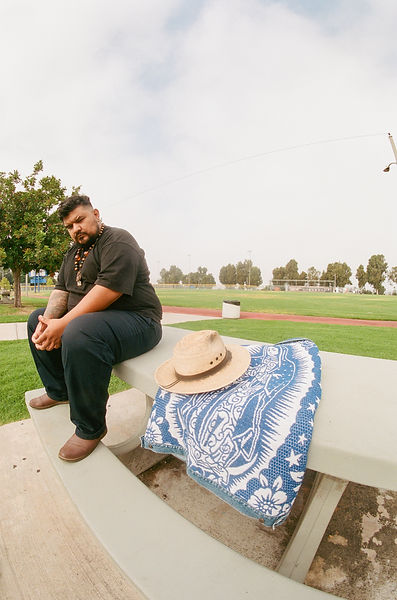
Andres, raised in Los Angeles, is a traveler, a tourist, a person on the move, but always centering his movement on the goal of assisting others. His therapeutic practice and music practice are reflections of these ideals. His “therapy office” is always moving, shifting between Inglewood parks, coffee shops, chess boards, and healing circles—like a true guerilla fighter, keeping the institution on their toes and always having fresh air in their lungs. A practice that isn’t just romantic to practice but has a true impact on his conversations. As FYPC photographed Andres in his city, and the park he takes his clients to, our photographer shared that Andres worked a little of his magic during the photoshoot—our photographer shared: “It was funny, I didn’t realize that this was a low-key therapy session! I was moving my feet, feeling the grass under my hands, really feeling the LA sun on my back—I didn’t notice how much I was opening myself up to Andres as we walked and talked. [LAUGHS]” It wasn’t institutional, it was about feeling safe to open up, hearing your language come out of someone else's mouth, letting your muscles move and unlock a memory that sat between your triceps/biceps/brain-lobes/other-muscles-that-we-don't-work-out.
As We Are Healing is a series that seeks to reimagine the foster youth image, it also pushes our institutions—with the fear that we might be making the oppressive force stronger, we are taking a chance that more hear and adopt the deinstitutionalized lens. That an overworked and underpaid social worker takes a minute between cases to read the crashing colors of Andres' approach——that his words reach the next grant writer and that everyone has access to a Chess board in the next funding cycle, that the next cohort of Social Workers aren't afraid of the word "abolition." With every walk he takes with his clients, with every word he wrote and spat, with every book spine he bent beyond recognition—Andres is moving the bar for healing to a level that made FYPC angry. Angry that we missed out on a form of care and healing that really was stewed in a pot of flavors from across the global liberation movement. That this project might have come generations earlier if the institution ever accepted a therapist with the Virgen bound to his back.


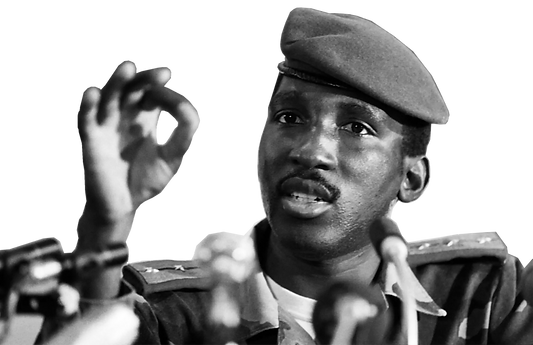
This collage highlights a few of the revolutionaries (Frantz Fanon, Malcolm X, Maria Moreno, Gloria Anzaldúa, Che Guevara, Oscar Zeta Acosta, Thomas Sankara) Andres highlighted during his conversation with our team members. At the end of our interview...Andres popped open his car trunk and pulled out a bag of CD's, over a hundred copies of these leader's speeches and interviews---it was a joke gift for Executive Producer because his car has a CD player, which is a tool that Andres thought "were extinct." After all the laughing, the gift was really a bag full of knowledge and the starting point for Andre's answers, when he was trying to figure out who he would become in his life.
When you turn to Andres’s music, we see even more of his push to center liberation and the destruction of our oppression. Using 2013 Soundcloud and not Spotify, is enough to say to this point—that the underground knows where to share their music when they have systemic -ism’s in their crosshairs.
On Andres’ Soundcloud, his music is uploaded under the stage name Mayazteca, and there, lives a set of projects that speak to the experiences the child welfare system believes to know. Here, on Mayazteca’s stage, we are bound to our chairs, eyelids stretched open, and third-eyes are being decalcified—facts are established early, in which systemic racism and personal responsibility are both true. FYPC looks towards Mayazteca’s project Freedom, as a track that best captures Andres’ abilities: mixing boom baps with a message.
With the opening line: “We have to struggle for ours.” The responsibility of freedom is never taken as a right we are granted—our “we” consists of a collective struggle and an understanding of oppression that does not need to be validated, or ever compared to itself. The power of Guerilla Hip-Hop is that its arms are open to all experiences and understands the importance of a needed collectively to change systems. His booming lyrics keep crashing down on our ears: “My people are fed up, tired of being used as pawns.” To know Andres is to know how important Chess is in his life, championing it as a great form of Play Therapy for all people—a game of skill, deep thought, and being able to manage the repercussions of every move you make. A great analogy for those navigating the margins, looking beyond the surface of our daily illusions—“They got you fooled with the jargon, read in-between the lines so you can outsmart them.” It is Andres’ ability to stop offering false hope that makes his words impactful, fighting against the false promises set in front of the oppressed identity: “Struggle takes time—Keep making history so your people last.” To really hear this track, the lyrics tear down the lies—or as Andres calls them “bullshit illusions”—we are tired when leaving our 9-to-5, oppression leaves PTSD that needs to be worked through, and Chess can be the start of where we learn to undo it all.
Andres wrote a few words to accompany his track, writing: “I put a lot of reflection into ‘freedom.’ At this point in my life I had gone through many struggles. Struggles in the community. Struggle with myself. Struggle against the beast. I began to evolve from here. Away from my aggressive attitudes towards all the f***ed up sh*t in this world. I realized that change is a slow process and that we must be patient. We must first learn to breathe before we learn to see.”


Below is a transcript of a conversation FYPC had with Andres at SouthLA Cafe! In front of our lens sat a guerilla hip-hop soldier that is still working to change the world with his words:
FYPC: Our conversation today is going to be looking more at your framework—so more about your "whys" and "hows" on topics of resistance, healing as a political act, race/ethnicity in child welfare, race/ethnicity in relation to healing, and race/ethnicity in approaching play therapy. You can kind of tell that I studied race and ethnicity! [BOTH LAUGH] Our first question will be direct: Can you please introduce yourself and describe in your own words, what your music and therapy practice looks like?
ANDRES: My name is Andres Ruiz, aka Mayazteca, which is what my artists' name was, is. I am a licensed Marriage and Family Therapist. I'm a mental health clinician. I've been working in the field in LA as a mental health clinician since 2018. But I've worked in the Los Angeles area since 2005. Since graduating high school, I've worked at different nonprofits. And the early part of my career, was very active musically. Once I graduated high school, I really started to realize that I had a talent for hip hop, and just kind of lyricism—I had a little bit of a traumatic experience in high school where an English teacher had made fun of some of my writing in front of the class. This was my freshman year in high school. And everybody laughed at me. And I remember kind of shriveling up, like a raisin a little bit, just feeling embarrassed, you know, but ever since then, I felt very self conscious about letting people read my writing, so I pivoted towards spoken word, giving myself that voice to be able to project what I write, so it sounds the way I wanted it to be heard. And so I started freestyling, creative writing, poetry, battling people in the bathroom at school.
After high school, I got into more like writing music, connecting with other artists. And then eventually, it just kind of blossomed into a very small, short lived career, doing a lot of shows, recording music, connecting with other artists—doing a lot of shows for community events, protests, getting invited to the Bay Area to do shows Live on underground radio, getting my music played in Latin America, in protest circles. And it was a really nice experience. And I thought I wanted to make that a career. But it really didn't go that direction. And so I did music for a little while, I put out a little album. I did spoken word, poetry. I helped youth high school students train in spoken word poetry at one point, and that was pretty cool.
And I think that really set the foundation for me for later on pivoting in mental health, being a very creative type therapist, you know, being playful—using music, using words, using play, using art, as my mediums to engage kids, or people who've experienced trauma, or people who traditionally won't seek out therapy and are sort of suspicious about, you know, a person with a badge, connected with the county or whatever. And so, I think that my music really helped me be versatile or fluid in that sense, as a clinician.
FYPC: Before we move forward, we want to know a bit more of your origins—Can you remember the first time you sang, rapped, or picked up an instrument? And what made you gravitate towards this type of art practice?
ANDRES: I was in eighth or ninth grade—And my homie called me one night, he was like "Yo, check out this rap song I wrote on this Snoop Dogg beat." He rapped it and it was cool, but I don't know for whatever reason in my head, I was like, "Man, I could probably do it just as good." And so I got the beat and then I started writing and then I called him back and I was like, "Yo, listen to my shit!" And then I rapped it over the phone. And he was like "foo, let's get together and let's start making music" and that's kind of how it started. He actually went on to become a recording artist. When I first started it was like Chicano gangsta rap. That's what I was into, I was a tag banger with my homies from Inglewood, and we used to hang out in Inglewood, Atlantic, South Central. And so like, we're into tag banging or whatever. And so we were into: Lil Rob, Mr. Knightowl, Diablo.
Tupac was my old school, or not my old school, but like he was coming up during that time. And his lyrics and his music had such a profound impact on me, the way he wrote his music, how we did storytelling, that was like a really big piece of my music and, projecting a story, right? telling it to you in a different way. Public Enemy, Rage Against the Machine was another major influence in my life. Pac was gangster shit, you know, when I lived in South Central, but he was also a revolutionary poet. So it was like, this dude talking about poverty, talking about all kinds of things that I can connect with—Pac and Rage, two really big influences for me.

FYPC: To your point, the experiences we have are just as important to producing our identities as the ones we are born with, the ones we inherit—we do want to move this conversation to a section we are calling: The Environment. And we're gonna read a little bit of what we wrote in a few sentences, and then we'll just kind of get your reaction to some of these ideas. The center of your work is located in Inglewood, a city with a deep history for people who have been historically marginalized in this country. And as a member of this city, and a member of historically marginalized identities—What does therapy mean to you through these cultural and environmental identities? What does healing look like for you?
ANDRES: Man, so Inglewood is one part of my identity, it's where I grew up when I was young and then I moved to South LA afterwards. But you know, I've always had strong connections on southwest side of Los Angeles, you know, South LA, Inglewood, Lenox, Hawthorne, Lawndale, Gardena, Watts, San Pedro, Wilmington, Long Beach. What I've tried to teach my clients, from these areas about healing is—And what I feel has worked for me is developing a sense of self awareness, your position in your life, your goals, your values, your principles, your environment, observing these things, studying them, unpacking them, studying yourself internally, which helps create self awareness because it helps gain insight in yourself. And it helps you strengthen your compass, the direction you go in life, because I believe that, when you are able to—I wouldn't describe it as fix, but explore, unpack and gain insight in your internal world—it has influence on the external world. It has ripple effects on your external world, the type of people you want to meet, the type of work that you do, the type of goals that you want to gain in life.
I think a lot of people operate with just what they see. They've never even looked inside. And they never thought about it. I think the more self aware you become of your own story the more clear your purpose comes to be. In psychology, we call it self-actualization. When you're trying to gravitate towards some larger growth goal or purpose in life. But some people don't know what that is. And some people spend all their life figuring it out. And some people figure it out early on, and just stick with it. When you are able to sit down and really think about these things: What is my purpose in life? What are my goals? I think you stop thinking in ordinary ways, and you start moving in extraordinary ways.
You know, I tell my clients, why do you want to live an ordinary life, go out and live an extraordinary life. You only got one, go explore the world, go eat, go travel, go meet new people. Because sometimes we get stuck in these cycles, and the cycles just leads us into hardship. Certain behaviors, habits and practices that we've adopted might not necessarily fit us in that moment and they just get us into trouble or cause distress.
That self awareness, the emotional intelligence, how you operate as a person, and how connected you are with our larger social organism. We don't exist in islands. We're influenced by people throughout our lives. And I think that the more aware you become of that process, I think, the easier it will be for you to map out the next paths or steps.
FYPC: In the West it might be called self-actualization and I wonder if other groups might call it 'finding consciousness"—And so I am wondering how might your forms differ from the more traditional medical Western approaches to healing and therapy? And if decolonization has ever entered your practice?
ANDRES: I think that word itself, decolonization, was such a big part of my life in the first part, when I was rapping and doing all that. Now, as a clinician, I think that it enters my practice in the way I assess a situation, when I look at a family, and I think about their history, and when I think about the succession of how they got to this level of dysfunctionality or individuals, and I think about certain behaviors that they have, that could have been passed down from generation to generation from generation. I always tell people that the experience of the colonization of the Americas had a profound psychological impact on those groups. If you look at the group as a whole, we experienced trauma and if you break it up into the millions of little pieces that we exist, it varies from person to person. There exists that experience of trauma, that internal trauma that was left there.
The process of self awareness and developing emotional intelligence, to me, definitely will lead you towards decolonizing your mind. Now, how do you decolonize your life, that's a different story, because we live in a capitalist society, we live in the hood, we live in a city that's different. Everybody's going to choose to what degree they want to sort of unpack or how far they want to go with that. But mentally speaking developing that self awareness, and that emotional intelligence can definitely help you liberate yourself, from ignorance, from being the colonized mind, and reach more consciousness. You carry yourself in a different manner.
I don't know if I attack it explicitly like that nowadays. Because not everybody is going to understand that, and some people will get turned off by that. Some people are just worried about their problems in the now you know but through the process of helping them become more self aware, they will just become better people, more well rounded individuals that are going to operate in this world with more consciousness.
FYPC: That's hella dope! Your work is very thoughtful—it feels like you translate these complex forms of healing into a language people trust. I know working in Social Welfare can be really difficult professionally and emotionally, how do you navigate these aspects of your career as a Brown therapist in South LA?
ANDRES: I should also mention my politics, because I think that that is a very major driving force in my life. In the early part of my life, I got really into radical politics. I told you last time, they called me a revolutionary tourist, because I was kind of going around with all types of groups: the Panthers, Brown Berets, a lot of indigenous resistance organizations, a lot of Pan-Africanist or Black nationalism organizations here in South LA. I sort of topped my career, with the Anarchists. I came to understanding revolution is a process of deconstructing and reconstructing. And this is either going to happen parallel to the system or internally within the system—the anarchist's were building shit, they were building collectives, building food, music groups, building co-ops and it was intergenerational. It had a pretty big impact on my perspective, and to some degree, I still consider myself an anarchist. But now, it's not so much that I'm active in the streets, trying to build those things. It's more that these principles guide my life, lifestyle and perspective.
My politics gave me a lot of perspective in navigating my career—I feel like a lot of these agencies are really just poverty pimps, bidding for these contracts. Executive directors are making $300,000 to $500,000 a year, and our case managers are making $40,000 a year, doing the brunt of the traumatic work. I feel that people take advantage of therapists because we're nice people, we're gonna be unconditionally positive all the time. You're willing to accept whatever pay they're willing to give, or you're willing to accept whatever crazy ass work you're willing to do. Why is that person at the top getting a fat paycheck a month, that equals to what one of my case managers making a year? It made me a type of employee that was not very loyal to any particular organization. But I was there, because I wanted to serve my community. That was my whole purpose, in my career, in anything I did. Even when I was a revolutionary kid, or in hip hop, it's always to serve—to serve my community in South LA, to make an impact in South LA. And I felt like I needed to do something more technical. And no, I, I obviously didn't go to medical school and I didn't become a lawyer, I became a mental health clinician. And I've pretty much spent my whole career working in South LA.
I haven't stuck with any particular ideology. But I just believe that, as long as you're a good person, you're willing to help others unconditionally without really expecting anything back—we can all become a more coherent social organism, and support ourselves and build a better community in South LA.



FYPC: Let's keep your last point going. When we first met, you shared that you believe members of the movement should have a degree or a trade. You brought up that Che was a doctor and Malcolm X was a lecturer, and you called yourself a street therapist. So I was wondering if you could tell me a bit more about what this phrase "street therapist" means to you and what that looks like?
ANDRES: I think you got to do whatever you're able to do, and take just what you need. I believe that the examples that I saw in other parts of the world, or that I read from revolutionary writers/leaders, they all played a very pivotal role in their community and in their circle. For me, when I was talking about revolution, and 'we got to build our own society,' parallel or internally inside of this system. You're gonna need teachers, you're gonna need doctors, you're gonna need lawyers, you're gonna need engineers, you're gonna need people to actually do these technical functions. We don't just need protesters.
I don't know if this is a controversial thing to say, but I say it because one of the reasons that I sort of pivoted away from music is because there was some degree of egotism to me involved in it, you know, and I wasn't about it anymore. The people that said these words that were revolutionary, didn't necessarily live the life. I'm saying, be great artists. But I know a lot of artists that are very egotistical, and they just want people to follow them. But they're not building anything.
As a street therapist, see, the way I was trained to be a therapist is not the way I did therapy for the first, five years of my career. [LAUGHS] So when you work in community based mental health, you don't really do traditional therapy, traditional therapy is done in a: controlled environment like an office room for 50 minutes per week, and then you end with a 'I'll see you next week.' Community based therapy is: you have to meet folks where they are at. You know, they might not want to be there, in therapy. So they're gonna make it harder for you to find them, and they're gonna make it harder for you to talk to them.
And so for me, with experience doing that type of work. The park was my therapy office, the school was my therapy office, my car was my therapy office, you know, the blocks, walking around the blocks was my therapy office. I'd be at Jesse Owens, I'd be at Helen Keller, I'd be at Magic Johnson, I'd be a Bethune. I'd be at all these different parts of South Central LA. Like, that's where I would take kids and people to talk. And so, I wasn't a traditional therapist anymore. I was in the streets, literally, sometimes I catch people on a street corner, and if they're my client and they've been dodging me, I'm gonna talk to you.
I'm gonna talk to you, however and wherever you're at, if you're walking towards a liquor store, then we're both walking towards the liquor store and we're talking—that's therapy technically, you know, I don't care if we are walking to a liquor store, and your going to get a 40 ounce, I'm gonna roll with you. And then we're gonna walk back and we're gonna talk or whatever. And so, it became street therapy. It became a very different type of therapy than one where people come to you and seek out your services—now, its one where you go out to them and you try to find them and honestly save them.
FYPC: Thats real! Maybe we can dive deeper into this thread and learn more about the "Power of Play" that you conduct with clients inside of a non-traditional therapy space. So to us as artists, the "Power of Play" might mean using movement to heal through internalized forms of trauma. And that movement can take different shapes, all of it connecting with our physical/emotional bodies—can you share with us what this framework means to you?
ANDRES: We all start off as children, and those first years of our life have a ripple effect on how we evolve. And I think that it's in our nature as human beings to play, it's a natural drive that we have. But when you don't play, what kind of impact does that have on your life? You know, what kind of ripple effects does it have on your personality? When I started studying these things, I'm working in the hood, so I'm sort of reading and being able to compare to my actual life, and I'm working after school programs in play, I'm doing soccer, I'm doing daycare work at the YMCA—I'm doing all kinds of enrichment programs, and then I became a clinician. I had a lot of experience in play, with kids in the hood. And I saw how playing, the act of playing lowers your guards. As an adult and as a kid you are having fun. For me, it's the foundation that I work off of.
Playing takes on so many different forms, you know, it could be playing with a child, playing in a team, playing by yourself, being playful as your personality with people. I think it's an overlooked concept because we take it for granted, we think it's for little kids, but I think that it has healing components to it when you embrace it and incorporate it in your life.


FYPC: We want to finally jump a little into your own music and how you navigate your own art practice as you work with others in their healing art practices—one of your lines from your project Cockroach People you say: "rap is a voice of the voiceless, a choice for the choice-less." We had a conversation yesterday with another therapist, with our focus on this concept of creating from the margins. So with your rhymes we know that you fully understand music as a space that was used by historically marginalized people to share experiences. We want to hear more about this from you—the importance of hip hop, the importance of music, and how that blends into healing.
ANDRES: Just like play, music must be programmed in us deep down inside as human beings. And it has these healing components that you feel when you hear a song or you hear the right lyrics. For me, I sort of knew I had this thing, about poetry and spoken word—I wouldn't say I found that easy to do. But when I did it, it came out nice. And people responded.
And so being from South Los Angeles, coming from immigrant parents, when I became self aware, conscious, I felt a responsibility to make my voice be heard. Tell my story, interpret the world through my eyes, so that other people can make sense of it when they hear it. Maybe they weren't getting it from another perspective. But they listened to Mayazteca. And they're like, "Yup, right, you know this foo said it right." I also just love music, I love art, I love to play. And I also just did it just for the sake of doing it, just because I enjoyed it, just because it was like my own therapy.
And to some degree when I was doing it, I had a little bit of ego. I liked the attention. But then when I got more into politics, I realized shit is serious. It is not just for show, this is real, and it sort of changed my perspective on it. And, and so I just felt like this responsibility as an artist at that time to be able to project my voice, to those individuals that may not have a voice or too timid to speak up.
FYPC: That speaks a lot to how I see your music practice, overlapping with your therapy practice. I have a question here. I'm asking more along the lines of why do you work in this space that only works with folks at an individual level? I mean, there's work that you could be doing at the national level, state level, we're you are influencing policy and trying to help a lot of people at once—you ended up going into a route that is one-on-one direct service work, can you share why you are working at this level?
ANDRES: So therapy can be seen as individual. And it doesn't have to be, it could also be very much of a group activity. It just depends on the clinician. But I believe that change is a slow process. I look at the Zapatistas—this is kind of where I got it from, where, you don't want to rush things. You have to let the community decide, you know, in America, the one politician decides because he got voted in, right. But in Chiapas, it's a process. It's a slow process, because they want to think through their action or their decision, rather than just make it based off of one individual. And I think that, for me, change is a slow process. It's an evolutionary, it's a deconstructing and reconstructing. I think for me I've never limited myself to just working with kids, just working with adults, just working with couples, just working with families, just working with Latinos, just working with this—I work with everybody.
I think that my degree can offer you a versatile career path, if you so choose to carve it out that way, some clinicians don't. But I think being from South LA, you sort of have to, you have to be versatile, you know, you can't just stick to one section, one sector or the other, like, you got to mess with everybody.
You got to be versatile. And so for me, my master's was in clinical and community psychology. So a big portion of my work is community psychology, and liberation psychology. Right now, we were talking about colonization and all that—I have to be broad scope to be able to do that kind of work. You know, I'm not just a child therapist, or just a traditional play therapist, or, you know, family therapist, I get around, like Tupac said.

FYPC: We are calling this section The Brown Buffalo—let me read this right off my paper: So the last time that we talked, you mentioned the Autobiography of a Brown Buffalo by Oscar Acosta. I've been reading the book since we last talked and I'm gonna be honest, Oscar is a problematic character to cheer on. But I still see parts of him that represent aspects of myself. And I love that he, as a person who is historically marginalized, doesn't follow the rules, because he seems to understand that following the rules is an oppressive act. Even if these rules keep us safe. Safety to him means we do not live a full life. Oscar shared that he wouldn't give up drinking or eating Mexican food, even though he had severe stomach ulcers that worsened with alcohol/spicy foods/drugs, because then that would be too bland of a life to live. He wasn't afraid of anything, and he wasn't afraid to say all that comes to him or afraid to express all that came to him. And I'm just wondering, since you recommended the book and his work, and your music project shares a similar title to his work, what aspects of his life do you resonate with and how do these forms of thinking impact your approach to healing, art making, and self expression as someone who shares marginalized identities?
ANDRES: I resonate with, this sort of rebel spirit. I'm a kid from the hood and he was a kid from the hood, and when we adopt revolutionary politics, it's never perfect, especially if you come from the barrio, you're gonna have your deficiencies. You're gonna have your flaws, your contradictions, you're gonna be a raging alcoholic, drug using, womanizer. And you're gonna be a revolutionary lawyer representing a movement, you know? And I think to some degree, I lived that lifestyle, especially when I was starting to develop my self awareness.
Yeah, I was a kid from South LA. I had homies who were Brown Berets. And some of us are going to college. Some of us are not, some of us are more radical than others. And I think that, it's just that that nature, about it, that really resonated with us at that time. Being cabrones, basically, you know, being sort of hooliganish types. I think that it was a little machista to be quite frank. But it's just what we were, you know what I mean? And being these desmadroso types, we were about it, when it came to getting down with white supremacists, we're the first ones on the front lines to get down with them, you know what I mean—
At the same time, we could be as as soft as a teddy bear, to children and families and community, because we saw ourselves as warriors in that sense. We weren't perfect. We were traumatized. We have baggage in our own life, but we were all non judgmental about that. And we just accepted it for what it was, we were on the same page about freedom and liberation and what we wanted to accomplish. But we weren't perfect at it. And I think Oscar was similar in that.
Hunter S. Thompson said in his eulogy for Oscar that Oscar was a prototype, a mutant that was never meant for mass production, and that will never be produced again. And for us, when I was in that—we were the brown buffaloes, we were those prototypes, we were like, "Nah, foo, there were more of him made." I mean, we weren't perfect. But I think with time you recognize your imperfections and you fix them, and then you evolve.
As I evolved from that space, I can't say that I embrace Che Guevara as much as I did when I first read him. I can't say I embrace Oscar Acosta as much as I—BUT that spirit of rebellion. That experience that they both had that led them to their purpose in life was fascinating to me. I feel myself similarly, I've lived that desmadroso life. I'm not perfect.
FYPC: And that's definitely in Brown Buffalo where I find myself confused, I love the idea of him rebelling. And then the language that he uses and how he expresses himself is difficult to—
ANDRES: It's raw and I love it.
FYPC: I'm accepting to be in conflict [laughing]
ANDRES: That's good because it's supposed to be provocative. We're social arsonists. My job as an artist is to ignite your imagination. And just let you marinate with that. And if not, then you're not doing your job. In healing, you're supposed to be uncomfortable, sometimes with music with art, with literature, you know, you're not always supposed to find inspiration, sometimes you are just supposed to feel.
I remember in that book, he's standing in front of a mirror. Just looking at his fatness. Yeah, I loved it, man. I was like, "Ah, this guy is just vulnerable...he doesn't care about anything that comes out of his mouth." Even though he wasn't saying the best thing. He was genuine about the worst shit.
